7 Signs You Have Hard Water in Bloomington

If your faucets crust over, your dishes come out spotty, and your skin feels dry no matter what soap you use, your home is trying to tell you something. You have hard water. And in Bloomington, that's the norm, not the exception.
Hard water isn't dangerous to drink, but it's hard on everything it touches. The dissolved minerals it carries leave deposits in your pipes, your water heater, and your fixtures, quietly shortening their life and driving up your bills.
The water in our area, supplied by the West Valley Water District, is generally hard. Below are seven signs to watch for. If a few sound familiar, it's worth knowing your options, because the damage builds slowly and the fixes are straightforward.
Key Takeaways
- Bloomington's water is generally hard; verify specifics against the latest WVWD water-quality report.
- White crust on faucets, spotty dishes, and dingy laundry are the everyday signs of hard water.
- Hard water builds scale inside pipes and water heaters, shortening their life and raising energy bills.
- A water softener is the most direct fix; filtration handles taste and other contaminants.
- Catching hard water early protects your fixtures, appliances, and plumbing from costly mineral damage.
Need a plumber in Bloomington, CA? We answer 24/7.
(207) 419-2600What is hard water, exactly?
Hard water is water with a high level of dissolved minerals, mainly calcium and magnesium. Rain picks these up as it moves through rock and soil before reaching the supply.
It's a mineral content issue, not a contamination issue. Hard water is safe to drink. The problem is what those minerals do over time, settling out as a chalky white residue plumbers call scale.
Across the Bloomington 92316 area and the broader I-10 corridor, the groundwater moves through mineral-rich soils, and the result is water that's generally hard. Hardness can vary from one part of the service area to another and from season to season, so the most accurate read is always the current West Valley Water District water-quality report rather than any single number. What stays consistent is that most homes here see the effects below.
Sign 1 and 2: Crusty faucets and spotty dishes
These are the two giveaways almost every Bloomington homeowner notices first.
White, crusty buildup around faucet spouts, showerheads, and the base of fixtures is scale. As hard water evaporates, it leaves its minerals behind. Over time that crust clogs the tiny holes in a showerhead and chokes the flow.
Spotty, cloudy dishes are the same story. You run a normal wash cycle, but glasses come out with a filmy haze or white spots that no amount of rinsing fully removes. That film is mineral residue drying on the surface, not leftover soap.
- Faucets and showerheads crust over and lose pressure
- Glassware looks cloudy or spotted straight from the dishwasher
- Chrome and stainless never quite look clean
If you're constantly scrubbing fixtures with vinegar, hard water is the reason.
Sign 3 and 4: Dry skin and dingy laundry
Hard water changes how soap behaves, and you feel it on your body and see it in your clothes.
Minerals react with soap to form a residue, sometimes called soap scum, instead of a clean lather. After a shower your skin can feel tight, dry, or filmy, and your hair may feel dull or limp. People often blame their soap or shampoo when the water is the real cause.
Laundry takes a hit too:
- Whites turn gray and colors fade faster
- Towels come out stiff and scratchy
- Fabrics wear out sooner because trapped mineral residue is abrasive
- You use more detergent trying to get a real lather
If your clothes never feel truly soft or clean, hard water is likely working against every wash. A whole-home water softener installation is the most direct way to fix the soap problem at its source.
Sign 5 and 6: Scale in appliances and rising energy bills
This is where hard water stops being an annoyance and starts costing real money.
Scale builds up inside anything that heats or holds water. Your water heater is the biggest victim. Minerals settle to the bottom of the tank as sediment, forming an insulating layer the burner has to heat through. That means longer heat times and higher energy bills, plus the popping and rumbling sounds many homeowners hear from an old tank.
You'll also see scale shorten the life of:
- Dishwashers and washing machines
- Coffee makers and kettles
- Ice makers and refrigerator water lines
A hard-water area is especially tough on tankless units, whose narrow heat-exchanger passages scale up fast without treatment. If you run one, our tankless water heater service includes the descaling these systems need to last. Either way, when energy bills creep up for no clear reason, scale is a prime suspect.
Sign 7: Low water pressure from scaled-up pipes
The seventh sign is one you can't see, and it's the most serious. Scale doesn't just coat fixtures. It builds up on the inside walls of your pipes.
Over years, that buildup narrows the pipe's interior, restricting flow the same way plaque narrows an artery. The result is gradually weakening water pressure throughout the house. You might notice it most when two fixtures run at once.
This hits older Bloomington homes hardest. Houses built with galvanized steel pipe are especially prone to it, because scale and corrosion combine to choke those lines from the inside. Once pipes are heavily scaled, no amount of cleaning fully restores them, and repiping with modern materials becomes the real fix. If your pressure has been fading for years, our water filtration systems can address water quality going forward, and we can assess whether the pipes themselves need attention.
What can I do about hard water in my home?
You don't have to live with the damage. There are two main tools, and they solve different problems.
- A water softener removes the calcium and magnesium that cause scale. It's the direct fix for crusty fixtures, spotty dishes, soap scum, and scale in your pipes and appliances. This is the single most effective step against hard-water damage.
- A water filtration system targets taste, odor, chlorine, and other contaminants. Many homes pair the two: a softener for scale, a filter for drinking-water quality.
The right setup depends on your home, your water, and what's bothering you most. We're glad to talk it through and recommend only what fits. You can reach out through our contact us page, and it never hurts to keep an eye on your water heater repair needs, since hard water is usually the reason a heater starts struggling early.
Frequently Asked Questions
Related Plumbing Services
Have a plumbing problem in Bloomington?
Don't let a small issue become an emergency. Call for fast, local, upfront-priced help.
Related Articles
All articles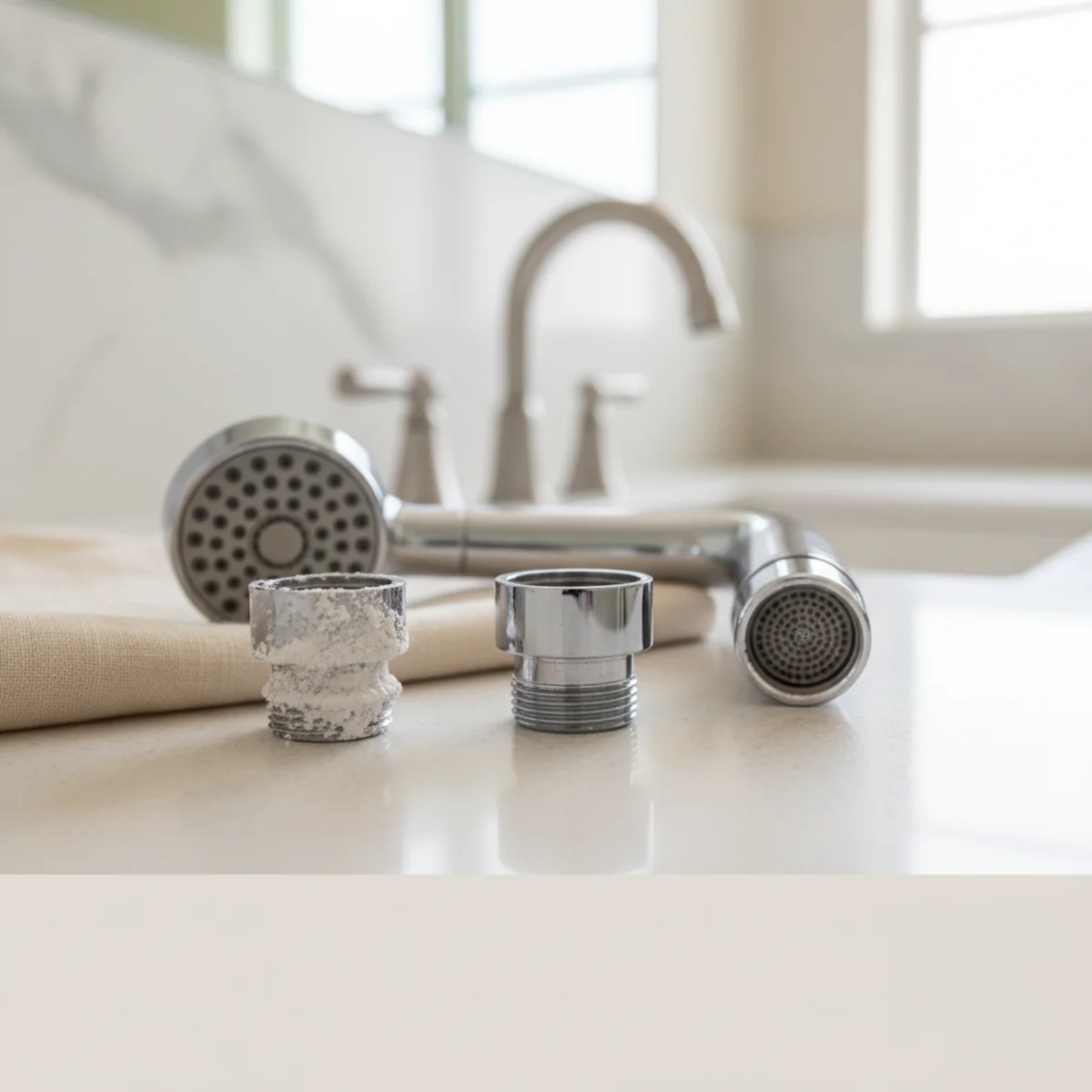 Bloomington Homeowner Tips
How Hard Water Affects Plumbing Fixtures
Crusty faucets and spotty dishes are just the start. Here's how Bloomington's hard water quietly damages your plumbing — and how to fight back.
Bloomington Homeowner TipsWater Filtration Options for Bloomington Homes
Want cleaner, better-tasting water? Here are the filtration options for Bloomington homes and how to choose between them.
Bloomington Homeowner TipsCommon Causes of Low Water Pressure in Bloomington, CA
Low water pressure has many causes, and hard water is a big one here. Here's how to track down weak flow in your Bloomington home.