Water Filtration Options for Bloomington Homes

You turn on the tap and the water looks fine. But you notice the spots on your glasses, the faint chlorine smell, the way the coffee tastes a little flat. You wonder whether you should be drinking it straight or buying bottled water by the case.
Here's the thing: Bloomington's tap water is treated and safe, but "safe" and "great-tasting" aren't the same thing. Our water is generally hard, and hardness, chlorine, and sediment all affect how water tastes, how it feels on your skin, and how it treats your fixtures.
Filtration fixes the parts you don't love without the cost and waste of bottled water. The trick is choosing the right system for what's actually bothering you. Here are your options for a Bloomington home and how to decide.
Key Takeaways
- Filtration improves taste, odor, and clarity; softening removes the minerals that cause hard-water scale — they solve different problems.
- Point-of-use filters (under-sink, faucet) treat drinking water at one tap; whole-house systems treat every fixture.
- Carbon filters handle chlorine taste and odor; reverse osmosis removes a much broader range of dissolved contaminants.
- Bloomington's generally hard water often calls for a softener alongside a filter, not instead of one.
- The right choice depends on your water test, your budget, and whether you want better drinking water or whole-home protection.
Need a plumber in Bloomington, CA? We answer 24/7.
(207) 419-2600What's actually in Bloomington tap water?
Your water comes from the West Valley Water District and is treated to meet safety standards before it reaches your home. So the question usually isn't safety — it's quality.
Three things tend to bother Bloomington homeowners. First is hardness. Our water is generally hard, meaning it carries dissolved calcium and magnesium. You can verify the specifics against the latest WVWD water-quality report, but you'll feel it as scale on fixtures and spots on dishes.
Second is chlorine. It's added to keep water safe through the distribution system, but it leaves a taste and smell some people dislike.
Third is sediment. Older mains and the occasional repair can introduce fine grit, especially in homes still fed by aging galvanized pipe.
Knowing which of these affects you most is the first step. A simple water test points you toward the right solution instead of guessing.
Filtration vs. softening: what's the difference?
People often use "filter" and "softener" interchangeably, but they do different jobs, and confusing them leads to disappointment.
A filter improves what you taste and see. Carbon filtration removes chlorine taste and odor; sediment filters catch grit and cloudiness. Filters make water more pleasant to drink and cook with.
A softener tackles hardness. It removes the calcium and magnesium that leave scale on faucets, cloud your glasses, and shorten the life of your water heater. Softening doesn't make water taste better — it makes it gentler on your plumbing and skin.
The reason this matters: if your main complaint is crusty fixtures and spotty dishes, a filter alone won't fix it. You need a water softener. If your complaint is taste and smell, a water filtration system is the answer. Many Bloomington homes benefit from both working together.
Point-of-use filters: drinking water at one tap
If your main goal is better-tasting drinking and cooking water, a point-of-use system is the simplest, most affordable place to start. It treats water at a single location rather than the whole house.
- Under-sink filters: A cartridge installed below the kitchen sink, often feeding a dedicated faucet. Great for drinking and cooking water without affecting the rest of the house.
- Faucet-mounted filters: A small unit that screws onto an existing faucet. Inexpensive and easy, though slower and lower-capacity.
- Reverse osmosis (RO): A multi-stage under-sink system that pushes water through a membrane, removing a much broader range of dissolved contaminants. The most thorough option for drinking water.
Point-of-use systems shine when you mostly care about what you drink. They're compact, cost less upfront, and pair naturally with a kitchen plumbing upgrade like a new faucet or pot-filler.
Whole-house filtration: treating every fixture
If you want filtered water at every tap, shower, and appliance, a whole-house (point-of-entry) system is the way. It's installed where the main line enters the home, so everything downstream is treated.
Whole-house systems make sense when your concern reaches beyond the kitchen — chlorine smell in the shower, sediment clogging fixtures, or simply wanting consistent water throughout the house. They also protect appliances and fixtures from grit.
A common Bloomington setup combines a whole-house carbon filter with a softener. The carbon stage removes chlorine taste and odor; the softener handles hardness. Together they cover taste, smell, and scale across the entire home.
These systems cost more upfront and need a bit more space near the entry point, but they deliver the most complete improvement. We size and place them based on your home's plumbing and your water test results.
How do I choose the right system?
Start with what bothers you most, then match the solution to it.
- Water tastes or smells off but fixtures are fine: A point-of-use carbon filter or under-sink RO usually solves it.
- Spotty dishes, crusty faucets, short water-heater life: That's hardness — you need a softener, possibly with a filter.
- You want better water everywhere, not just the kitchen: Look at whole-house filtration, often paired with softening.
- You're on a tight budget: Start point-of-use at the kitchen and expand later.
The smartest first move is a water test so you're treating real problems, not guesses. From there, we'll recommend the smallest system that genuinely fixes your issue rather than overselling capacity you won't use.
If you're weighing options, contact us and we'll walk through what your Bloomington home actually needs.
What about maintenance and long-term cost?
Every filtration system needs upkeep, and ignoring it defeats the purpose. A clogged or spent filter can slow flow and stop working without you noticing.
Point-of-use cartridges typically need changing every few months to a year, depending on use and capacity. RO membranes last longer but still need periodic replacement, along with the pre- and post-filters. Whole-house carbon media is replaced on a longer cycle.
Softeners need salt added periodically and an occasional cleaning. With our generally hard water, that resin works hard, so don't skip it.
Factor maintenance into your decision. A cheaper system with frequent cartridge changes can cost more over time than a larger system with longer service intervals. We'll lay out the realistic upkeep before you commit so there are no surprises down the road.
Frequently Asked Questions
Related Plumbing Services
Have a plumbing problem in Bloomington?
Don't let a small issue become an emergency. Call for fast, local, upfront-priced help.
Related Articles
All articles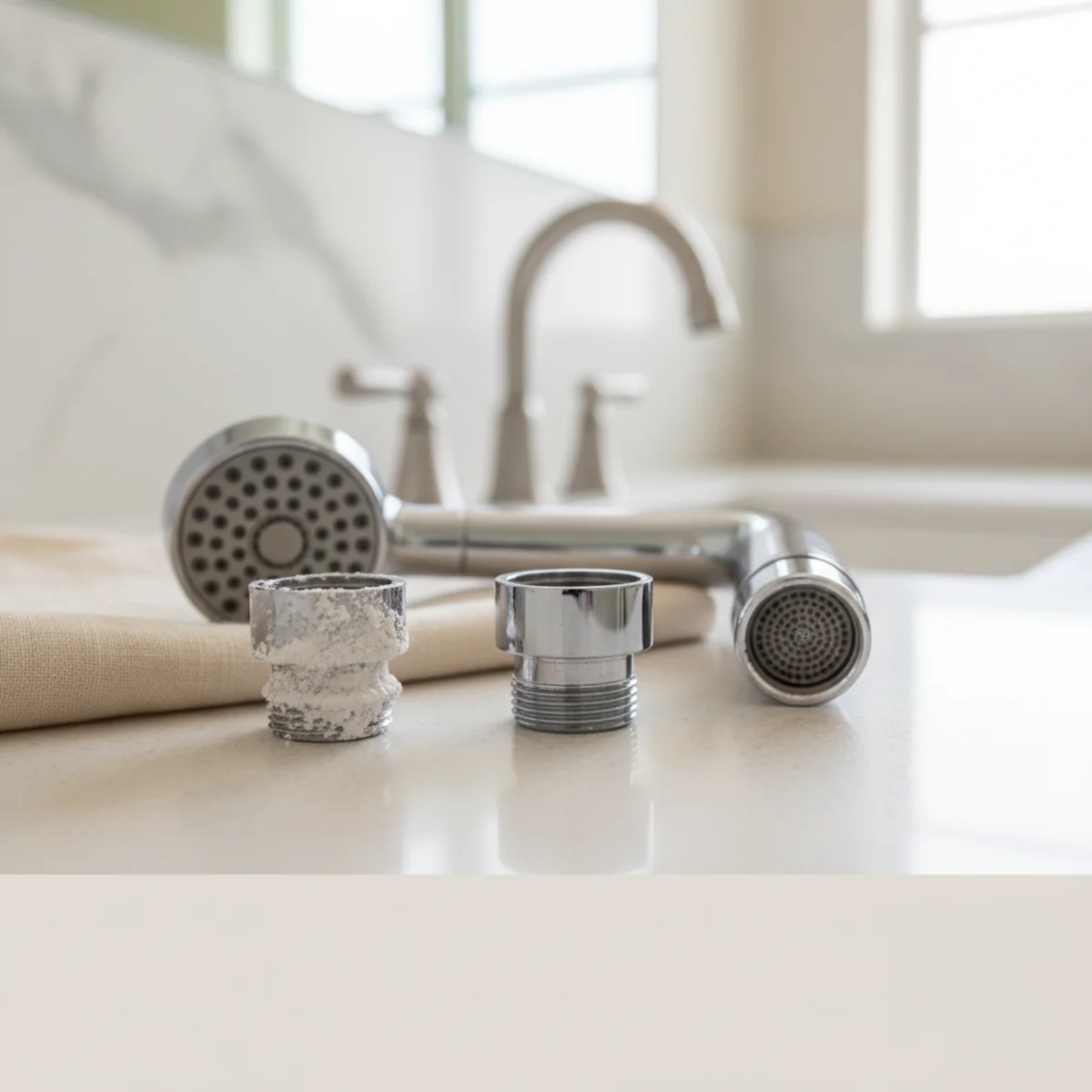 Bloomington Homeowner Tips
How Hard Water Affects Plumbing Fixtures
Crusty faucets and spotty dishes are just the start. Here's how Bloomington's hard water quietly damages your plumbing — and how to fight back.
Bloomington Homeowner Tips7 Signs You Have Hard Water in Bloomington
Spotty dishes, crusty faucets, dry skin — your home may be telling you it has hard water. Here are 7 signs to watch for.
Bloomington Homeowner TipsCommon Causes of Low Water Pressure in Bloomington, CA
Low water pressure has many causes, and hard water is a big one here. Here's how to track down weak flow in your Bloomington home.