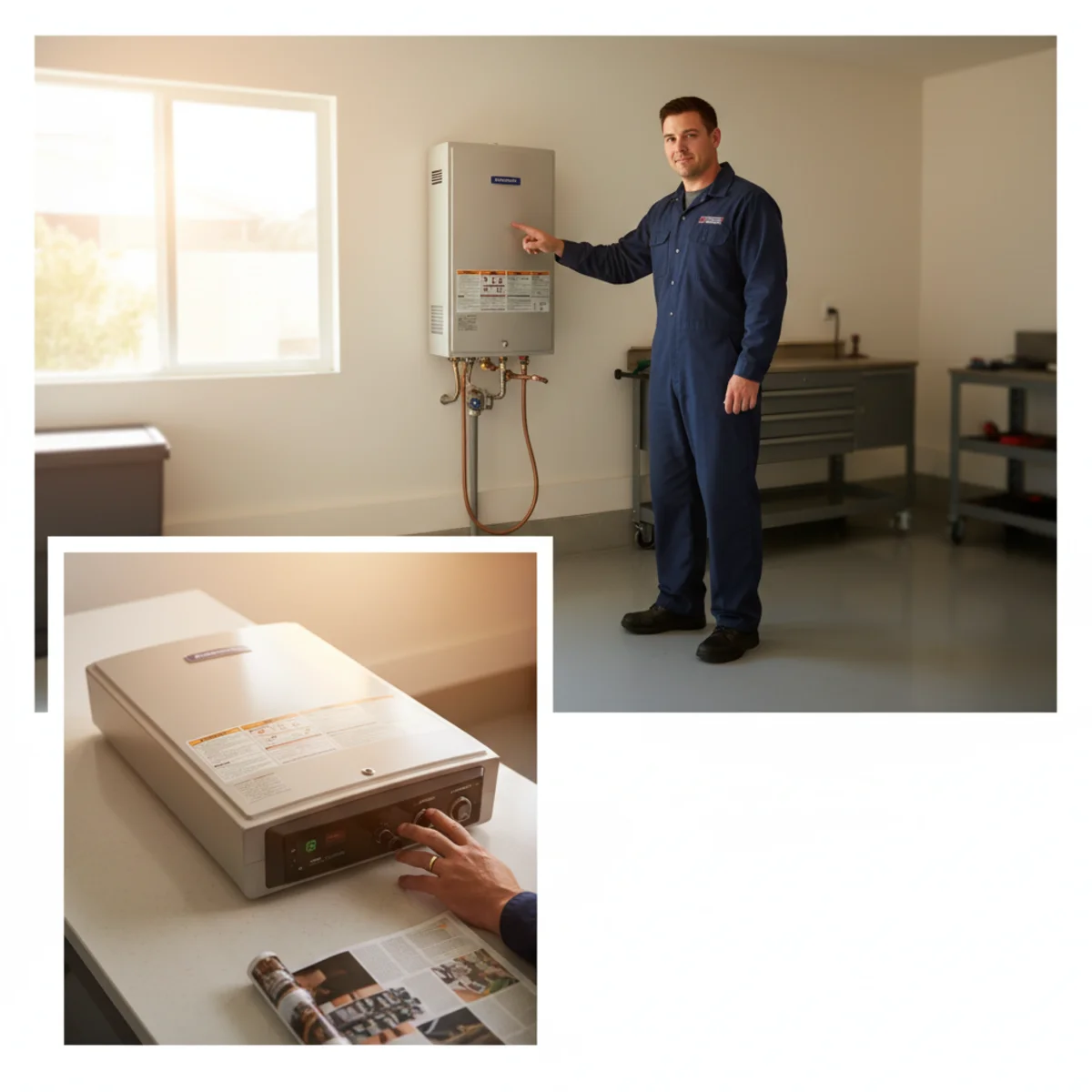
You walk into the garage and find a puddle under the water heater. Maybe it is a small ring, maybe it is spreading toward the boxes you stacked nearby. Either way, your stomach drops. Is this a quick fix or a four-figure replacement?
Here is the hard truth: a leaking water heater never gets better on its own, and water near a tank only gets worse. Left alone, a slow drip can rust the base, soak drywall, and in the worst case the tank can fail and dump dozens of gallons at once.
The good news is that not every leak means the tank is done. Some come from fittings and valves you can repair. Others are the tank itself telling you it is finished. Below is how to figure out which one you are dealing with.
Key Takeaways
- Leaks from fittings, the drain valve, or the T&P valve are often repairable; a leaking tank body usually is not.
- Water pooling under the center of the tank generally points to internal corrosion and replacement.
- Bloomington's hard water speeds up sediment buildup and corrosion, shortening tank life.
- Shut off the water and the power or gas to the heater before investigating a leak.
- A water heater past roughly 10 to 12 years that is leaking from the tank is usually worth replacing, not repairing.
Need a plumber in Bloomington, CA? We answer 24/7.
(207) 419-2600First step: is it actually leaking, or just condensation?
Before you panic, rule out condensation. On a humid day, or right after a big hot-water draw refills the tank with cold water, droplets can form on the outside and drip to the floor. That looks like a leak but dries up and does not return.
A real leak is persistent. Wipe everything dry, lay down a paper towel or two where the water collects, and check back in a few hours. If the paper is wet again with no humidity to blame, you have a genuine leak.
Once you confirm it, find the source before you do anything else. Trace the water uphill to where it starts. The fix depends entirely on where the water is coming from, and the locations below each point to a different problem and a different solution.
Leaks from fittings and connections at the top
Water at the top of the tank usually comes from the cold inlet or hot outlet connections, the nipples where the pipes screw in. These can loosen over time or corrode where dissimilar metals meet.
Often this is a repairable leak. A plumber can tighten the connection, replace a failed nipple, or swap a corroded union and stop the drip without touching the tank.
- Check whether the water is tracking down from a fitting above, not seeping up from below.
- Look for green or white crust at threaded joints, a sign of slow corrosion.
- Flex connectors and dielectric unions are common failure points worth inspecting.
Because the tank itself is sound in these cases, this is one of the cheaper outcomes. Our water heater repair team can confirm whether a top-side leak is a simple fitting fix.
Leaks from the drain valve or the T&P valve
Two valves on the tank are common, fixable leak sources.
The drain valve sits near the bottom, used to flush the tank. It can fail to seat fully after a flush or wear out and weep. Sometimes a cap or a new valve solves it.
The temperature and pressure relief valve, or T&P valve, is the safety device usually on the top or upper side with a discharge tube running down. If it is dripping, it may be a worn valve, or it may be warning you of a real problem like excessive pressure or an overheating tank.
A dripping T&P valve is not something to cap off and ignore. It is a safety valve doing its job. Have it checked, because the cause can be thermal expansion or a failing thermostat. Both valves fall under standard water heater repair.
Leaks from the bottom of the tank itself
This is the outcome nobody wants. If water is pooling under the center of the tank and you have ruled out the valves and fittings, the steel tank has likely corroded through from the inside.
Inside every tank is a sacrificial anode rod that corrodes in place of the steel. Once that rod is used up, the tank lining starts to go. Bloomington's generally hard water accelerates the sediment and corrosion that wear a tank out.
A tank that is rusting through cannot be patched safely. The fix is replacement. If the unit is past roughly 10 to 12 years, replacement is almost always the right call rather than chasing repairs. When that day comes, our water heater installation crew sizes and installs the new unit and hauls the old one away. It is also a good moment to consider a tankless model.
Why hard water and skipped maintenance cause leaks
Most premature water heater failures around here trace back to two things: hard water and neglect.
Hard water drops minerals that settle as sediment in the bottom of the tank. That layer insulates the burner from the water, makes the heater work harder, traps heat against the steel, and speeds corrosion. It also wears out the anode rod faster.
The fix is maintenance. Flushing the tank once a year clears sediment, and checking the anode rod every few years lets you replace it before the tank pays the price. A whole-home water softener cuts the mineral load at the source and protects every appliance, not just the heater.
Folding the heater into a regular plumbing maintenance routine is the cheapest way to push off a replacement.
What to do the moment you find a leak
Act quickly to limit damage, then call a pro.
- Shut off the cold-water supply with the valve on top of the heater, or use your home's main shutoff if needed.
- Kill the power. For an electric unit, switch off its breaker. For gas, turn the control to off.
- Move anything stored nearby and soak up standing water so it does not reach drywall or framing.
- Do not keep using hot water while the tank is leaking.
If water has already spread into walls or flooring, that is a job for water damage plumbing repairs on top of fixing the heater. A leaking tank can fail suddenly, so do not wait. We are available around the clock at upfront flat-rate pricing. Reach out through contact us and we will get the leak diagnosed and stopped.
Frequently Asked Questions
Related Plumbing Services
Have a plumbing problem in Bloomington?
Don't let a small issue become an emergency. Call for fast, local, upfront-priced help.
Related Articles
All articlesWater HeatersWhy Your Water Heater Is Not Producing Hot Water
A cold shower is a bad way to start the day. Here are the usual reasons a water heater stops making hot water — and what to check.
Water HeatersHow Long Do Water Heaters Last?
Wondering how much life your water heater has left? Here's how long they typically last and what shortens that in our hard-water area.
Water HeatersTankless vs Traditional Water Heaters for Bloomington Homes
Endless hot water and lower bills, or lower upfront cost and simplicity? Here's how tankless and tank water heaters compare for Bloomington homes.